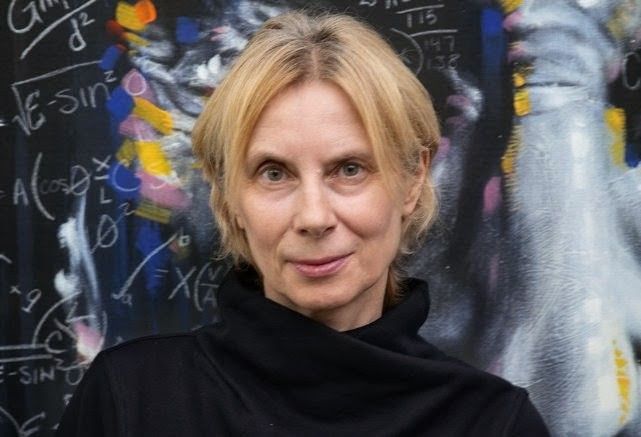
Dr. Manuela Campanelli
(updated July 13th 2026)
Dr. Manuela Campanelli is an absolute titan of modern astrophysics, celebrated for cracking one of the most famously intractable problems in Albert Einstein’s general theory of relativity. As the John Vouros Endowed Professor and Director of the Center for Computational Relativity and Gravitation (CCRG) at the Rochester Institute of Technology (RIT), she builds the supercomputing models that allow humanity to simulate, see, and understand the most violent gravitational events in the cosmos.
The Genesis: The Post-Einstein Wall
Born and educated in Italy, Manuela earned her PhD in physics from the University of Perugia before embarking on a highly ambitious research track across Europe and the United States. Her focus was a century-old mathematical wall: numerical relativity (using supercomputers to solve Einstein’s field equations).
For decades, physicists could write down the equations for a single, stable black hole, but trying to simulate two black holes orbiting and crashing into each other caused the supercomputer simulations to crash instantly. The mathematics of curving spacetime simply broke the software code, rendering the dynamic evolution of binary black holes a theoretical blind spot.
The Ascent: The “Moving Puncture” Breakthrough
In late 2005, while leading a research group at the University of Texas at Brownsville, Manuela and her team executed a monumental breakthrough that fundamentally changed computational physics.
- The Moving Puncture Method: Alongside her collaborators, she introduced a revolutionary mathematical technique known as the “moving puncture” approach. Instead of trying to fix the messy, infinite coordinates inside a black hole’s singularity, this method allowed the mathematical singularities (the punctures) to move freely across the supercomputing grid.
- Simulating the Invisible: The code stabilized perfectly. For the very first time in human history, scientists could simulate the entire lifecycle of a binary black hole merger—tracking them as they spiraled together, collided, and formed a single, massive black hole.
- Predicting the Ripple: Her simulations yielded precise, clean waveforms predicting exactly how gravitational waves—literal ripples in the fabric of spacetime—should look as they travel across the universe.
The Focus: Multi-Messenger Astronomy and Jet Mechanics
Manuela’s modern research infrastructure focuses on mapping supermassive black hole dynamics and processing data from global observatory networks:
- The LIGO Vindication: When the Laser Interferometer Gravitational-Wave Observatory (LIGO) made history by detecting gravitational waves for the first time, the real-world cosmic signals perfectly matched the theoretical waveforms that Manuela’s moving puncture simulations had mapped out a decade earlier. Her work provided the immediate visual and mathematical blueprint that verified the historic discovery.
- Supermassive Collisions and Jets: Her lab at RIT runs massive, high-performance computing simulations tracking supermassive black holes at the centers of galaxies. Her teams don’t just simulate gravity; they integrate magnetohydrodynamics (the behavior of magnetized fluids) to model how these cosmic monsters swallow matter and shoot out relativistic plasma jets across millions of light-years.
- Institutional Leadership: As a Fellow of the American Physical Society (APS) and the recipient of the prestigious Richard A. Isaacson Relativistic Award, she continues to direct multi-million dollar federal research grants, guiding the next generation of astrophysicists as they prepare for next-generation space-based gravitational wave detectors like LISA (Laser Interferometer Space Antenna).
“For decades, simulating a black hole merger was a grand challenge that seemed impossible. Finding the right mathematical key didn’t just fix our code—it opened a brand new window to look at the universe through gravity instead of light.”
The Visionary of Spacetime
Dr. Manuela Campanelli remains a defining architect of multi-messenger astrophysics. By transforming Einstein’s abstract field equations into stable, predictive supercomputer code, she didn’t just solve a mathematical crisis—she gave experimental astronomers the literal cipher needed to read the hidden, gravitational soundtrack of our universe.
• • •
Latest Posts
- #QuantumBiology #Neuroscience #Consciousness #Physics #Biophysics #Astrobiology #TheBrain #HavanaSyndrome #AnnomalousHealthIncindentEver wonder where “you” actually end and the universe begins? Most of us think of our thoughts as just biological sparks, but what if the reality is much more… fundamental?It’sContinue reading “#QuantumBiology #Neuroscience #Consciousness #Physics #Biophysics #Astrobiology #TheBrain #HavanaSyndrome #AnnomalousHealthIncindent”
- 2026. Havana SyndromeElectromagnetic Fields & Propaganda When you combine electromagnetic fields (EMF) with propaganda, you’re looking at a two-pronged attack on human agency: one that targets the hardware (the brain’s electrical signaling)Continue reading “2026. Havana Syndrome”
• • •
 "The Game" The Future is Female!