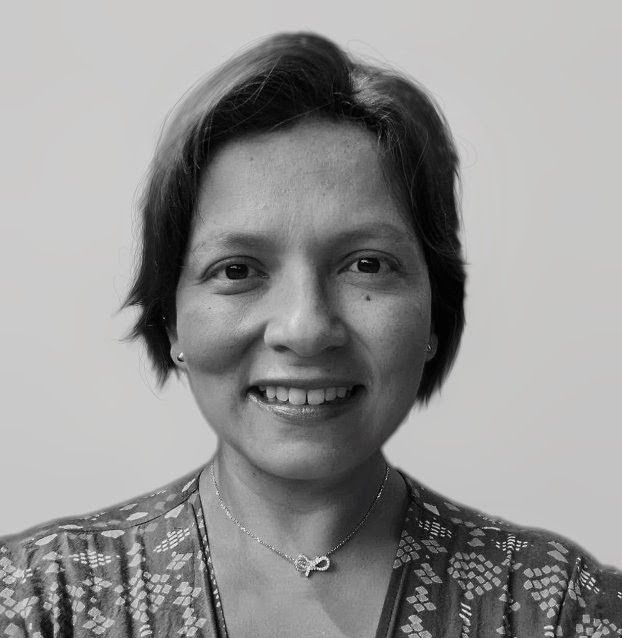
Dr. Paola Pinilla
(updated July 13th 2026)
Dr. Paola Pinilla is a revolutionary figure in modern astrophysics, celebrated for solving one of the most agonizing, decades-old paradoxes in planetary science. As an Associate Professor in Exoplanets at University College London (UCL), her work bridges abstract fluid dynamics and high-resolution telescope observations, revealing exactly how cosmic dust survives long enough to build planets.
The Genesis: The Cosmic Radial Drift Barrier
Born and raised in Bogotá, Colombia, Paola was inspired early on by Carl Sagan’s Cosmos. After completing her physics training in Colombia, she pursued her PhD at Heidelberg University in Germany, focusing on the highly problematic physics of protoplanetary discs—the churning rings of gas and dust spinning around infant stars.
For generations, astronomers faced a crushing math problem known as the “radial drift barrier”. According to classical physics models, as tiny dust grains in a young disc collide and grow into millimeter-sized pebbles, the friction from the surrounding gas causes them to lose velocity rapidly. Instead of growing larger, these proto-planetary building blocks should spiral inward and burn up in the host star within a fraction of an astronomical second. According to pure theory, rocky planets like Earth should not exist.
The Ascent: Mapping the Cosmic “Dust Traps”
Paola refused to accept the statistical inevitability of cosmic destruction. Combining advanced numerical hydrodynamics simulations with cutting-edge radio astronomy data, she helped unlock the mathematical key to planet survival.
- The Pressure Bump Paradigm: Paola proved that gas discs around young stars are not smooth gradients. Instead, magnetic turbulence and gravitational shearing create localized high-pressure rings—essentially “pressure bumps”.
- The Cosmic Dust Traps: These pressure bumps act as cosmic safe havens. Instead of drifting helplessly into the star, pebbles get caught in these high-pressure tracks, safely aggregating and clumping together over millions of years until they gain enough mass to form the rocky cores of future worlds.
- Observational Vindication: When the Atacama Large Millimeter/submillimeter Array (ALMA) in Chile took its first ultra-sharp images of young stars, it revealed stunning, concentric rings of bright dust—perfectly validating the precise geometric “dust traps” that Paola’s theoretical models had mapped out.
The Focus: The Chemical Cradle of Life and Elite Laurels
Paola’s current era centers on using advanced space observatories to track how the literal ingredients for life are distributed across newborn solar systems:
- Tracking Cosmic Water: Utilizing data from the James Webb Space Telescope (JWST) and ALMA, her research group at UCL models how organic molecules, hydrocarbons, and ice lines migrate through these pressure traps, revealing how water ultimately reaches forming planets.
- A Sweep of Global Prestige: Her mathematical resolution of the planet-formation paradox has triggered a cascade of major global awards. Following her 2024 New Horizons in Physics Prize from the Breakthrough Foundation and the 2025 Price Medal from the Royal Astronomical Society, she was officially named a 2026 Blavatnik Awards Laureate in the United Kingdom for her transformative contributions to the physical sciences.
“Our work is deepening our understanding of the first steps of planet formation using theoretical models and observations of discs around young stars. As Carl Sagan once said, ‘The cosmos is within us. We are made of star stuff.'”
The Weaver of Worlds
Dr. Paola Pinilla stands as an indispensable architect of modern astronomy—proof that challenging a fundamental theoretical bottleneck can rewrite our understanding of the universe. By exposing the invisible magnetic and pressure networks that rescue cosmic pebbles from stellar destruction, she didn’t just solve a 50-year astrophysics puzzle; she mapped out the literal mechanics behind how our own home planet came to be.
• • •
Latest Posts
- #QuantumBiology #Neuroscience #Consciousness #Physics #Biophysics #Astrobiology #TheBrain #HavanaSyndrome #AnnomalousHealthIncindentEver wonder where “you” actually end and the universe begins? Most of us think of our thoughts as just biological sparks, but what if the reality is much more… fundamental?It’sContinue reading “#QuantumBiology #Neuroscience #Consciousness #Physics #Biophysics #Astrobiology #TheBrain #HavanaSyndrome #AnnomalousHealthIncindent”
- 2026. Havana SyndromeElectromagnetic Fields & Propaganda When you combine electromagnetic fields (EMF) with propaganda, you’re looking at a two-pronged attack on human agency: one that targets the hardware (the brain’s electrical signaling)Continue reading “2026. Havana Syndrome”
• • •
 "The Game" The Future is Female!