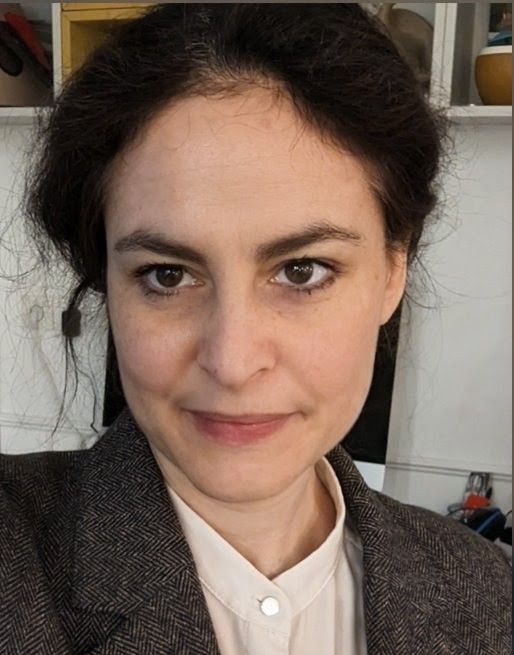
Dr. Valentina Parigi
(updated July 13th 2026)
Dr. Valentina Parigi is a pioneer of quantum optics, charting a career defined by an ambitious shift away from standard quantum hardware paradigms. Instead of manipulating individual, isolated particles of light, she builds massive, interconnected optical networks where information is woven directly into the continuous waves of the electromagnetic field. As a Professor at Sorbonne Université and a senior researcher at the historic Laboratoire Kastler Brossel (LKB) in Paris, she is constructing the physical backbone of the next-generation quantum internet.
The Genesis: The Tuscan Foundations and the Photon Maze
Born in Italy, Valentina built her mastery of optical physics at the University of Florence and the European Laboratory for Non-Linear Spectroscopy (LENS), completing her PhD with deep insights into non-classical states of light. Her early work focused on traditional quantum foundations—learning exactly how to isolate, subtract, and manipulate photons.
When she joined Sorbonne Université and the LKB, she realized that building a massive, functioning quantum computer purely out of discrete single photons faced a devastating scaling bottleneck. Tracking and routing millions of individual particles required an impossible maze of physical detectors, mirrors, and switches. She decided to discard the single-particle blueprint completely and pivot to a fluid, continuous-variable framework.
The Ascent: The Multimode Multiplexing Mastery
Valentina did not try to build thousands of separate lasers to create a quantum network. Instead, her lab pioneered Multimode Quantum Optics—using a single, ultra-fast femtosecond pulsed laser to generate a massive cocktail of overlapping light frequencies and time slots simultaneously.
- Continuous-Variable Networks: Rather than utilizing binary 0 and 1 states of single photons, her lab encodes quantum information into the continuous properties—the amplitude and phase quadratures—of light waves.
- Frequency and Temporal Multiplexing: By passing a pulsed laser through custom-engineered non-linear crystal waveguides, her team splits a single beam of light into a highly organized, multi-dimensional grid of entangled quantum modes. This allows her to generate highly complex, reconfigurable quantum networks (or “cluster states”) within a incredibly compact, physical table-top setup.
- Quantum Reservoir Computing: Merging physics with machine learning, Valentina’s lab successfully demonstrated that these optical networks can function as a “quantum reservoir”. By using the natural, complex physical mixing of light waves to process data inputs, her setups can solve intricate machine learning tasks with far greater information capacity than classical computing architectures.
The Focus: Scale, Sovereignty, and Prototyping
Valentina’s current era centers on transitioning these massive tabletop optical networks into robust, scalable prototypes for the global tech infrastructure:
- The PEPR Quantum Mandate: Valentina serves as a central leader within the French national quantum strategy (PEPR). Operating under the OQuLus project, her lab is actively spearheading the development of physical, continuous-variable prototypes designed to make photonic quantum computing commercially viable.
- The QICS Hub: As a co-director of the Quantum Information Center Sorbonne (QICS), she helps steer Paris’s premiere interdisciplinary ecosystem, bridging the gap between abstract quantum software programmers and raw laboratory hardware engineers.
- Advocacy and Leadership: A highly visible figure in international optics circuits—frequently delivering definitive lectures on complex networks at global summits from Japan to the US—she is also a prominent advocate for structural equity in physics, co-authoring manifestos to reshape scientific leadership paradigms for women in deep tech.
“We are discovering that we don’t need to struggle to isolate individual particles to build a quantum computer. By using continuous light waves and organizing them into multi-dimensional geometric shapes, we can build stable, massive networks inside a single beam of light.”
The Weaver of Quantum Networks
Dr. Valentina Parigi remains a definitive vanguard of optical statecraft. By replacing rigid, single-photon engineering with fluid, multi-frequency wave architectures, she has decoupled quantum hardware from its historical scaling limits. Her work ensures that when the global quantum internet arrives, its information will travel across the organic, hyper-efficient wave structures she engineered in her Paris laboratory.
• • •
Latest Posts
- #QuantumBiology #Neuroscience #Consciousness #Physics #Biophysics #Astrobiology #TheBrain #HavanaSyndrome #AnnomalousHealthIncindentEver wonder where “you” actually end and the universe begins? Most of us think of our thoughts as just biological sparks, but what if the reality is much more… fundamental?It’sContinue reading “#QuantumBiology #Neuroscience #Consciousness #Physics #Biophysics #Astrobiology #TheBrain #HavanaSyndrome #AnnomalousHealthIncindent”
- 2026. Havana SyndromeElectromagnetic Fields & Propaganda When you combine electromagnetic fields (EMF) with propaganda, you’re looking at a two-pronged attack on human agency: one that targets the hardware (the brain’s electrical signaling)Continue reading “2026. Havana Syndrome”
• • •
 "The Game" The Future is Female!