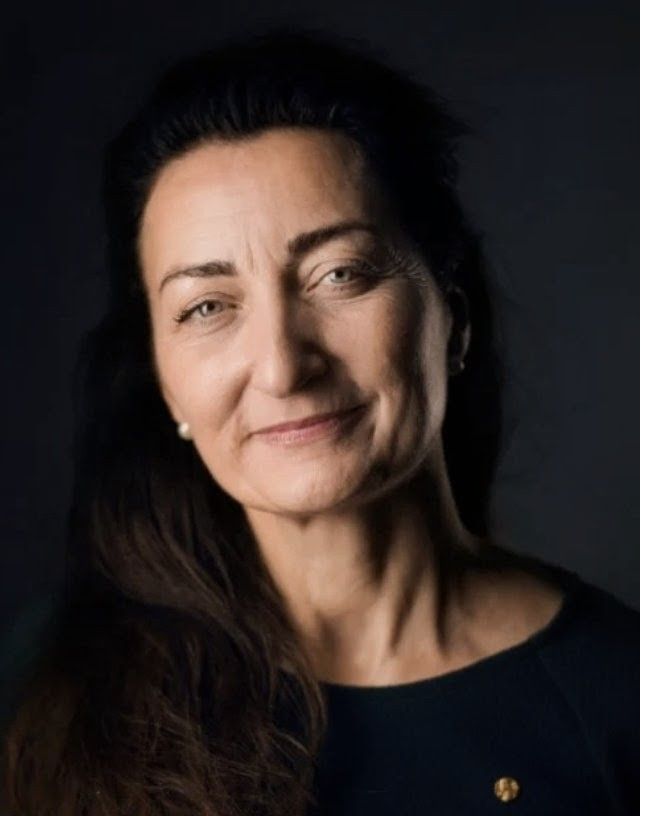
May Britt-Moser
(updated May 11th 2026)
May-Britt Moser’s life is a journey through the labyrinth of the mind—a narrative that began on a remote farm on the Norwegian coast and ascended to the pinnacle of scientific achievement in Stockholm. Her story is one of cartography, not of lands, but of the internal GPS that allows every living creature to navigate the world.
The Genesis: The Island Dreamer
Born in the small town of Fosnavåg, May-Britt grew up surrounded by the wild, jagged geography of Norway’s islands. This environment fostered a deep, innate curiosity about how animals understand their place in space. While her early academic path wasn’t immediately certain, her passion for psychology and the mysteries of the brain led her to the University of Oslo.
There, she met her long-time collaborator and former husband, Edvard Moser. Together, they formed a scientific partnership that would become one of the most productive in modern history, driven by a shared dream: to find the physical location of memory and spatial awareness.
The Ascent: Mapping the “Inner GPS”
The Mosers’ work moved from the theoretical to the revolutionary when they established their laboratory at the Norwegian University of Science and Technology (NTNU) in Trondheim. They were searching for the brain’s “coordinate system,” and in 2005, they found it.
The Discovery of Grid Cells: They identified “grid cells” in the entorhinal cortex—a type of neuron that fires in a hexagonal pattern, acting like a mental graph paper. This discovery provided the first evidence of how the brain creates a map of its surroundings.
The Nobel Laureate: In 2014, May-Britt was awarded the Nobel Prize in Physiology or Medicine, becoming only the eleventh woman to receive the honor in that category. She stood on the world stage as a symbol of how meticulous, basic research can unlock the deepest secrets of human existence.
Fighting the Fog: Her work transitioned from pure discovery to clinical hope. By understanding how the brain’s navigation system works, she opened new doors in the fight against Alzheimer’s disease, where the loss of spatial orientation is often the first heartbreaking symptom.
The Dream: Decoding the Human Experience
May-Britt Moser’s dream is defined by an insatiable hunger to understand what makes us “us.” Her vision for the future of neuroscience includes:
The Architecture of Memory: Uncovering how our sense of space is linked to our sense of time and personal history.
A Future Without Dementia: Using her foundational discoveries to develop therapies that can repair or bypass the neural circuits damaged by neurodegenerative diseases.
Inspiration through Wonder: As a high-profile female scientist, she dreams of fostering a world where young girls see the lab as a place of adventure and “playful” discovery.
“The brain is the most complex thing in the universe. To understand how it works is to understand our own soul.”
The Pioneer of the Mind
May-Britt Moser remains a vibrant, empathetic force in the scientific community. Known for her infectious enthusiasm and her ability to explain the complex “ballet” of neurons with poetic clarity, she has bridged the gap between the cold data of the laboratory and the warm reality of the human spirit. Her life serves as a reminder that to know where we are going, we must first understand how we know where we are.
My Latest Posts
• • •
- #QuantumBiology #Neuroscience #Consciousness #Physics #Biophysics #Astrobiology #TheBrain #HavanaSyndrome #AnnomalousHealthIncindentEver wonder where “you” actually end and the universe begins? Most of us think of our thoughts as just biological sparks, but what if the reality is much more… fundamental?It’sContinue reading “#QuantumBiology #Neuroscience #Consciousness #Physics #Biophysics #Astrobiology #TheBrain #HavanaSyndrome #AnnomalousHealthIncindent”
- 2026. Havana SyndromeElectromagnetic Fields & Propaganda When you combine electromagnetic fields (EMF) with propaganda, you’re looking at a two-pronged attack on human agency: one that targets the hardware (the brain’s electrical signaling)Continue reading “2026. Havana Syndrome”
• • •
 "The Game" The Future is Female!